

Tattoos and facial paintings made with achiote and huito dye were once very common, usually displayed at large feasts or initiation rituals. Male and female ornaments are made with various jungle materials, using toucan feathers, beetle wings and a variety of seeds (Brown, 1984).
Face painting is different between men and women, as Efrain comments:
"Men use their hands to paint a line on their face, and women use a thin stick to make dots on their face". Efrain, Achu Community, Cenepa river.
Face paintings have a special meaning for certain members of the Awajún people, as they can symbolise authority, especially given to warriors. The distinctive dye they used to differentiate themselves from others is tipak or huito. For some members of the Awajún people, these markings represent authority, which is granted to the warriors. The dye they use is to differentiate themselves from others, as Mariluz tells us:
"Mostly at the party they paint themselves (...) only at the masateo, minga, after so much work, they already sit down to drink, but already dressed, changed because they are going to dance. The facial paintings are sometimes attractive, but sometimes when there are strong warriors, when there are warriors the men paint themselves black with huito or Ipak. They use achiote for normal festivities, such as family gatherings.” María Luzmila, San Antonio community, Cenepa river.


The use of feather crowns are still in use in the Awajún-Wampis world. They are sometimes used for celebrations, meetings or presentations to authorities. There are two types of crowns called Tawas. A crown made with a Tsentsak frame, a fibre made from the petiole of the leaves of the ungurahui palm tree (Jessenia bataua), adorned with toucan feathers. It is worn by chiefs or people of prestige, or for visiting social events. The other crown is woven from tamshi or chambira fibres, with large and small toucan feathers attached; some might also carry macaw feathers.

In addition, the crowns incorporate a detail called akitai tuwik, a pendant of green beetle (tuwik) elytra and toucan (Ramphastos cuvieri) feathers secured with beeswax. This is placed as a complement to the tawas. These crowns are made by men and take approximately two days to make.
The pecheras or nunkun are made using huayruro seeds and "virgin's tears;" a hard, tear-shaped seed that is naturally grey or white. The pechera is made by both men and women, although it is more commonly used by men. These pieces have a special meaning in their culture and are traditionally worn by the wise men of the Awajún-Wampis people or on occasions to show their commitment to women. Efraín comments:
"The ancients used these when they had their missions, but not just anyone used it. Now it is used by leaders, teachers, artisans, and mayors". ~Efrain, Achu Community, Cenepa River.

The traditional Awajún-Wampis dress is made from cotton, cultivated and woven on a handmade loom. Men's clothing was based on a skirt or itipak, fastened at the waist by a belt. Women wore a one-piece dress, known as a "buchák or taráchi", which was tied over one shoulder with a rope, and also fastened at the waist with a belt (Brown, 1984).
Another detail of the women's dresses is the datem, an ornament made of seeds of the same name, which is attached to the shoulder of the dress; it holds the secrets of their lovers: "a lock of hair or something that they have given her."
The use of this dress have transformed over time, giving rise to the traditional Awajún-Wampis dress, as it is known today:
"In the old days they used to dress in leaves, the girls were wrapped in dried banana leaves because there was no sale of fabrics, and the fathers required the expert ladies to weave the cotton, but some of them had to plant their own cotton to gather, and there were those who could not.... there was a tree called Kamush, (yanchama). They would peel the bark off, then would have to beat it and put it in water so that all its hardness came out to make it into a pure fibre. They washed it, they sunned it, then they started to sew it with the chambira fibre thread." ~Luzmila, San Antonio community, Cenepa river.

The akachu is another traditional ornament made from women's hair, traditionally worn by men. In historical times, they were strung from the hair of the enemy as a victory emblem after a confrontation, having won a battle.
Another ornament used by men was the pigshajiitai, a woven ribbon with toucan feathers on the back, which the men used to tie up their hair with. The akachu kugku is a belt adorned with seeds and fragments of the congompe snail (Bulimus maximus) from which it gets its name. It is worn by women in celebrations and dances.


Women usually wear the pataku or a bracelet made of beads, which usually convey patterns strung from white, black and red seeds. Another adornment that both men and women usually wear is the akita, which are earrings made of toucan feathers. These were worn during daily activities, such as the preparation of masato. Other bracelets worn by women are the pataku kugku, made from extremely fine beads and rainforest snail shells.

The unuch is a necklace worn by children up to two or three years of age. It is made from a snail. It is said that the snail was "so weepy" that it was left with a hollow mouth. Children wear this necklace so that the snail will talk to them and tell them that if they cry, they will end up like it (Formabiap, 2004). The kugku is a necklace worn and made by women. It is also made from a snail shell.
Currently, many Awajún women are organized through associations of craftswomen, who are dedicated to the elaboration and promotion of bio-jewelry designs from the seeds of plants and trees that they cultivate themselves. We are proud to partner with the association YAPIT with whom we hosted a bio-jewelry workshop at the Xapiri Ground gallery in 2024 where the elaboration of pieces using the kumpia seed took place.
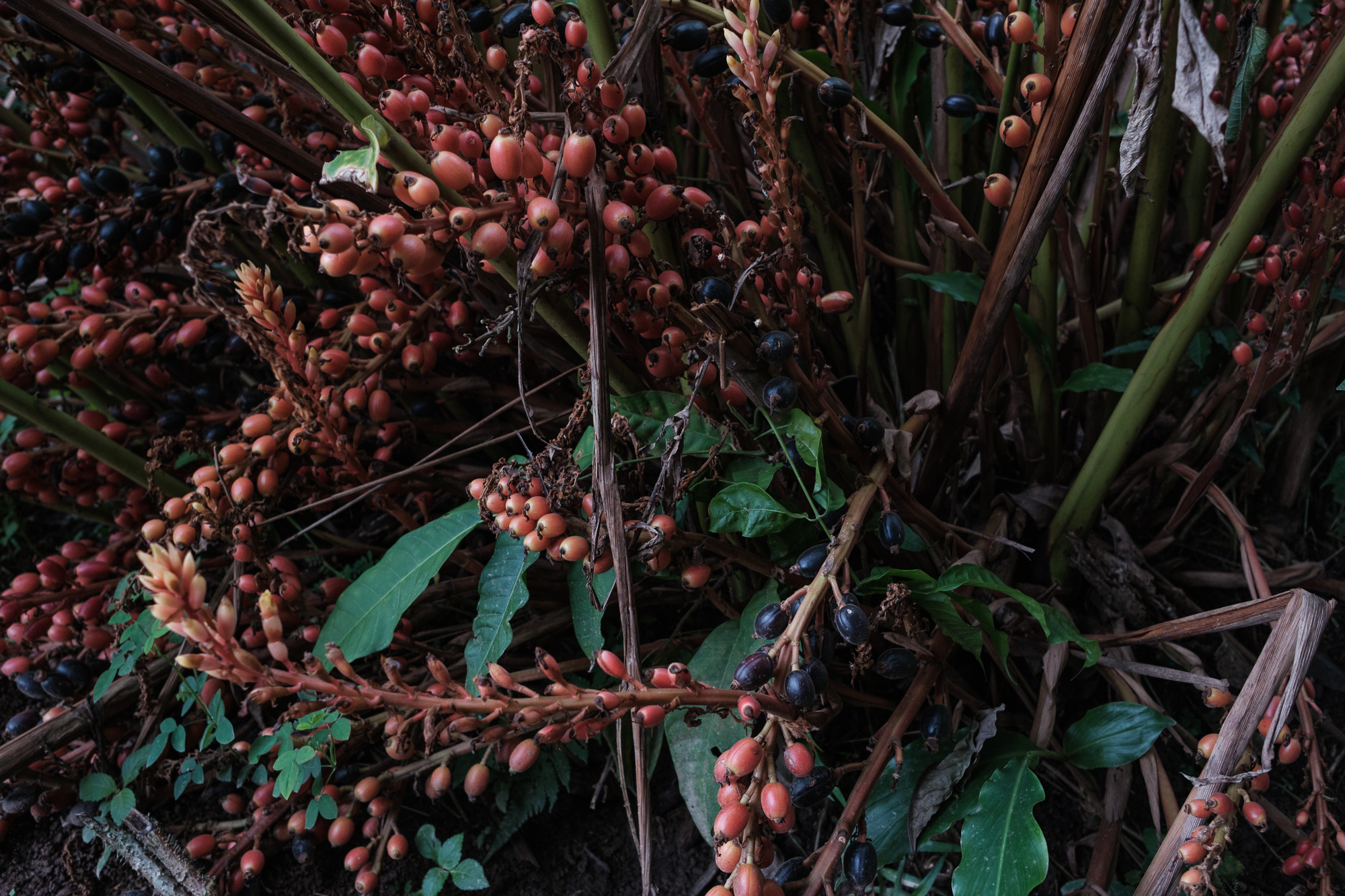
The fruit of the Renealmia alpinia features an edible aril containing tiny seeds known to the Awajún as kumpia; a cornerstone of Awajún bio-jewelry, prized for its natural aesthetic and its place in Amazonian flora. These seeds are mostly harvested in November, marking the start of a meticulous preparation process whereby the seeds get separated from the pulp, dried, and then hand-drilled with tiny holes using a sharp metal tip.
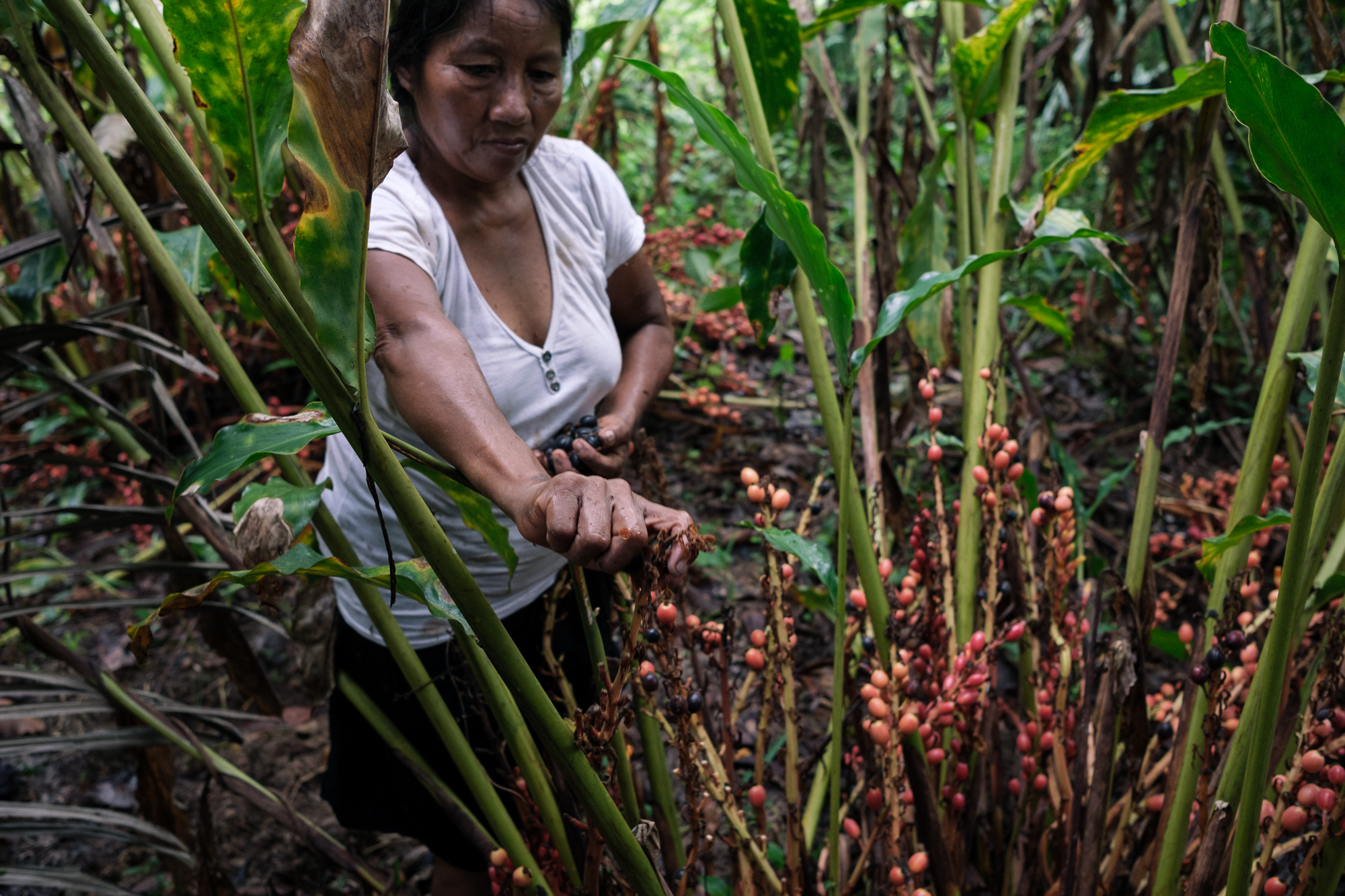
This craft is primarily the domain of Awajún women, who artfully fashion the beads into their bio-jewelry such as necklaces, braceletes, and earrings. The resulting pieces feature structural loops and forms that echo the intricate geometric patterns and painted designs found on their traditional ceramics.


.png)